01 What can it take in?
Ask where your recipes are now, then check that list against theirs.
Every manager on page one takes a link. Past that they differ, and here we lose. Their
import net is wider than ours: CookBook takes Instagram, TikTok, YouTube, Facebook,
Pinterest, Reddit, PDFs, Apple Notes, handwritten cards, screenshots, a Chrome and Edge
extension, and a bulk CSV of 250 recipes at a time, most with a help article to prove
it. Pantry Pal takes six sources through five buttons — a link, a TikTok or Instagram
or YouTube video, a photo of a cookbook page, an EPUB or PDF you upload, or one typed
in by hand. (EPUB and PDF share the one upload button, so that's six sources behind
five buttons.) The recipe organizer page walks
through all six; the short version is that a video gets listened to and its caption
read, and that EPUB is the one source we take and they don't — a whole cookbook,
worked through chapter by chapter. Nothing you import lands in your library until you
approve it on a review screen.
02 What does search cover?
Almost nobody publishes this. Ask anyway.
"Searchable" is doing a lot of work in this category, and the limits only show up at
300 recipes. Ours is narrow and here it is: free text search covers the recipe title
and the description, and nothing else — not the instructions, not the ingredient list,
not your notes. Ingredient, tag, and category are filters, so you pick a value rather
than typing one, and you can file recipes into chapters you name. There are two sorts:
newest first, and how much of each recipe is already on your shelf. If searching the
full text of every method you've ever saved is the job, we're not the tool — and
check the same field on whatever else you are weighing, because the answer is rarely on
the marketing page.
03 What does it run on?
The row we lose worst, so we will put it first.
CookBook is the one to beat: iPhone and iPad, Android, and a genuine web app you sign
in to at app.cookbookmanager.com, all on one plan — and the browser is included even on
their free tier. Recipe Keeper covers iPhone, iPad, Android and Windows, though you
buy the unlock a platform at a time. Pantry Pal is web-only. It runs in your browser,
on a phone or a laptop, and there's no native package of any kind: no store listing,
nothing to sync locally, no version of this that works with the airplane mode switch
on. Everything is server-backed and scoped to your household, so any browser you sign
in from is the same cookbook, and everyone in the house sees the same one. If what you
want is something from an app store, we're not it, and you should go and get one.
04 What does it cost in year three?
We lose this one at every horizon, so read it and decide early.
CookBook is $39.99 a year, or $6.99 a month, in US dollars. Pantry Pal Pro is $59.99 a
year, or $7.99 a month. They're cheaper at every horizon, and on a three-year view a
perpetual licence beats both of us — Paprika is $4.99 once on iOS, and Recipe Keeper's
iOS unlock is $19.99, both of them sold per platform. Price isn't our argument and
we're not going to dress it up as one. Both of us are free to start; if the rest of
this page isn't worth the $20 a year to you, spend it somewhere better.
05 Does it remember your kitchen?
This is the question, and it is the one we built the product around.
Start with the strongest counter-example, because it is a good one. CookBook's
Leftovers tool filters your own saved recipes against ingredients you name or
photograph, shows a count of how many of them each recipe matches, and since July 2025
it can sort those results by the fewest extra ingredients you would have to buy. Their
AI Fridge tool takes a clear photo of the fridge and reads the ingredients off it,
which is less work than typing. That's a real answer to the same question and it
deserves saying before anything else.
Here's the difference, and it's re-entry rather than memory. CookBook stores nothing
about your kitchen between sessions, so the next time the question comes up you put
the whole lot in again, by typing the ingredients in or by taking another photo of the
fridge. Paprika does keep a real pantry — a quantity, a purchase date, an expiry date,
an in-stock flag, and a restock from the grocery list, free of charge — but nothing in
the product joins that pantry to choosing a recipe, so you end up reading your own
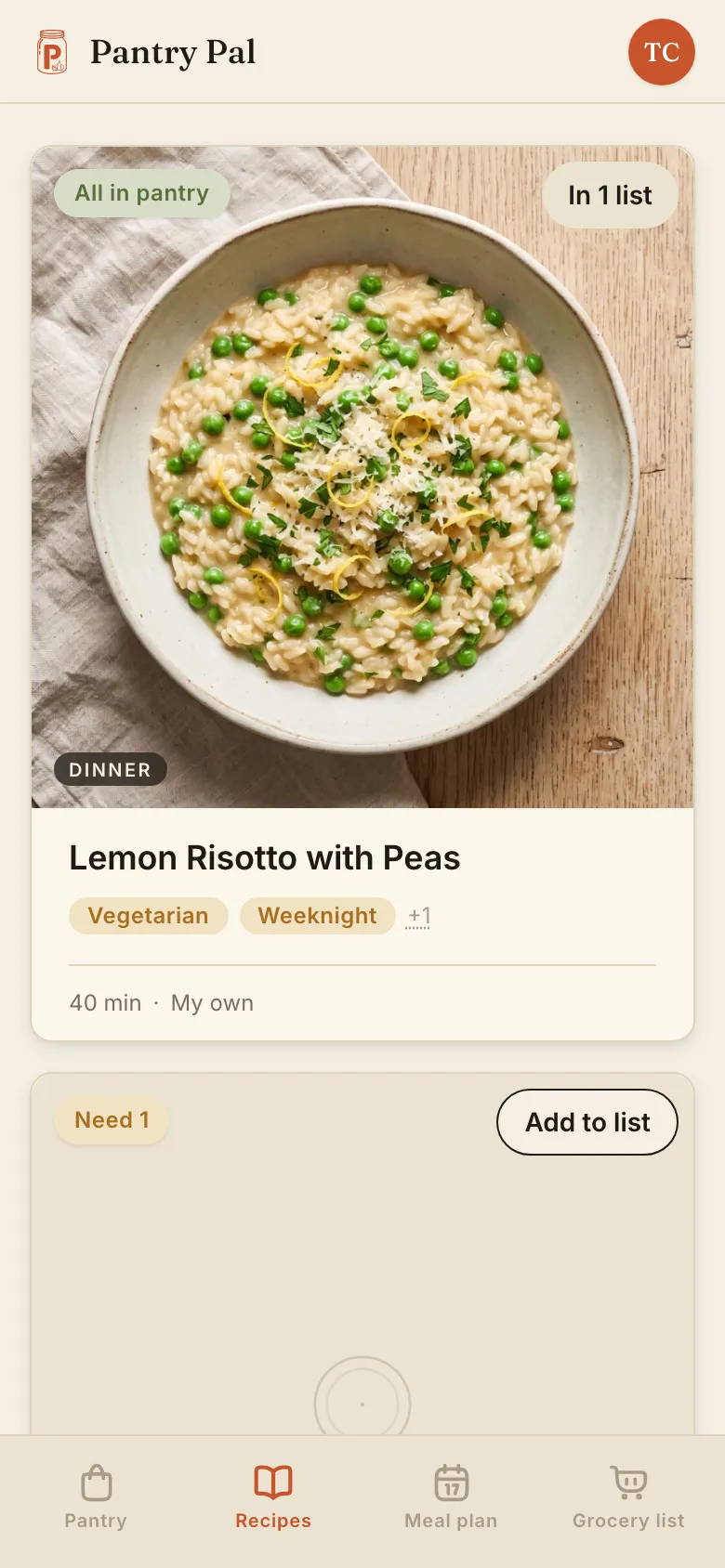
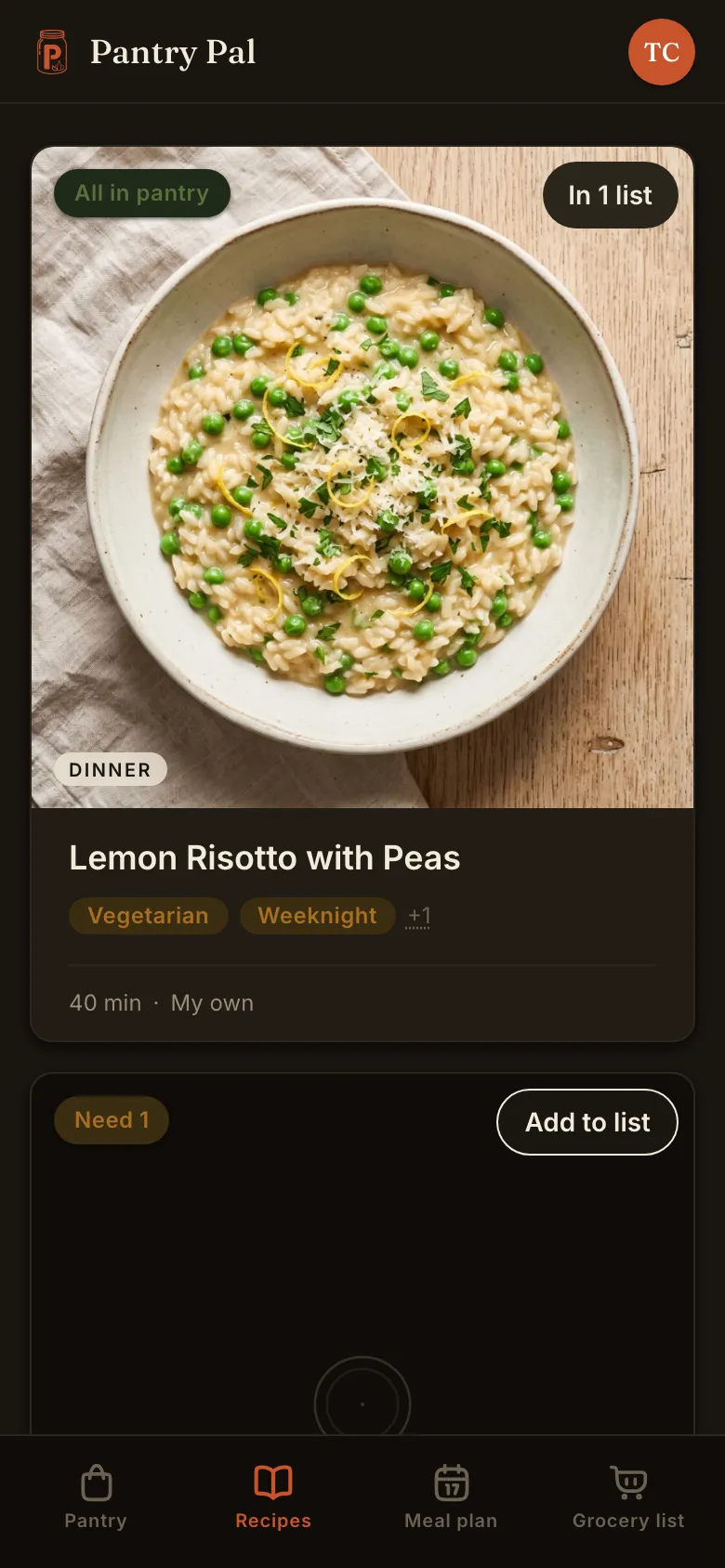
pantry screen and retyping it into a search box. One of them holds the matcher and the
other holds the record. Neither holds both, so either way you build the answer again
from scratch.